Cut urban transport energy use by 70% with mobility shift, reducing oil dependence, says new report supported by FIA Foundation

Investing in electric mobility, public transport, walking, and cycling can strengthen energy security, while reducing countries’ exposure to volatile global fuel markets, says new research led by the Institute for Transportation and Development Policy (ITDP) with UC Davis, supported by the FIA Foundation.
The report, Compact Cities Electrified: Energy Outlook, analyzes Brazil, China, India, Indonesia, Mexico, and the United States, representing nearly half of the world’s population and a range of oil and gas producers and importers. The research us particularly relevant given global fuel crises and volatility. Key findings included:
The research examines how different combinations of vehicle electrification and shifts toward public transport, walking, and cycling could affect energy demand and fossil fuel imports through 2050.
The findings are significant: pursuing electrification and mode shift together:
- could cut energy use from urban passenger transport by around 70% and liquid fuel demand by 85% by 2050.
- The combined approach could also reduce gross oil and gas imports by between 11% and 57% - approximately 2.5 billion fewer barrels of oil equivalent imported each year across the six countries compared with business as usual.
Less oil dependence, greater resilience
Under the report’s most ambitious mobility scenario: combining electrification with mode shift, gross oil and gas imports in the six countries would fall by approximately 2.5 billion barrels of oil equivalent annually by 2050, compared with business as usual. Depending on the country, imports could be 11% to 57% lower.
Indonesia could reduce projected gross oil and gas imports by 57% by 2050, Brazil by 51%, Mexico by 34%, the United States by 30%, India by 17%, and China by 11%.
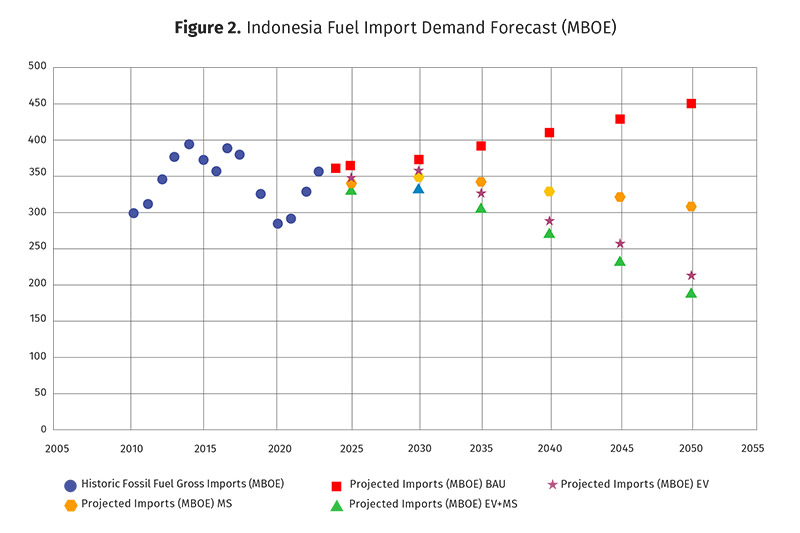
Crucially, the analysis highlights that electrification alone is not enough. The greatest energy-security benefits come when countries electrify vehicles while simultaneously reducing dependence on private cars by making public transport, walking, and cycling more attractive and practical. Electrification and mode shift also reinforce each other: progress in one can help protect countries when progress in the other falls short.
The economics of that transition are also changing. While global oil and gas markets have been volatile, battery costs have fallen by more than 90% since the early 2010s, strengthening the financial case for transport electrification.
From short-term relief to long-term energy security
The report argues that governments facing high fuel prices have a fundamental policy choice: temporarily shield consumers through fuel subsidies or invest in structural measures that reduce fuel demand.
Fuel subsidies may provide immediate price relief, but they also encourage continued fossil-fuel consumption, place pressure on public finances, and leave countries exposed to the next price shock. They can also disproportionately benefit wealthier households that consume more fuel. By contrast, investments in electric mobility, public transport, walking, cycling, and compact urban development permanently reduce the amount of oil required to move people and economies.
The benefits extend beyond energy security. Previous modeling underlying the analysis finds that a system of safe, shared electric mobility could save governments USD $600 billion, reduce urban passenger PM2.5 air pollution by 67%, and prevent 170,000 road deaths annually by 2050.
The report calls on governments to prioritize policies that support compact, mixed-use cities; expand high-quality public transport; build safe walking and cycling networks; manage private car use; accelerate vehicle electrification; expand charging infrastructure; and use measures such as aggregated procurement and zero-emission vehicle standards to bring down costs.
“Electrifying transport is becoming an energy-security strategy, not just a climate strategy,” said Heather Thompson, ITDP´s Chief Executive Officer. “Countries cannot control the price of oil or prevent the next global supply disruption. But they can reduce how much oil their economies need. Building cities around efficient electric mobility, public transport, walking, and cycling gives governments greater control over their energy future.”
“The lesson from previous energy crises is that the choices governments make during moments of disruption can shape their economies for decades,” indicated Sheila Watson, FIA Foundation Deputy Director. “Energy resilience depends not only on securing more supply, but on reducing demand. The most durable protection against the next oil shock is an urban transport system that simply needs less oil.”
Read the report, 'Compact Cities Electrified: Energy Outlook'